

Imagine a promising prospect leaves their contact details on your website and uploads the first documents or information required for assessment, quotation or policy issuance. Today, it often takes days for the lead to reach the right sales team, for documents to be reviewed, and for policies to be created and signed. Valuable opportunities are lost during this time.
This turns a potential customer into a satisfied policyholder more quickly, while your sales organisation operates more efficiently and at greater scale.
Series: Digital Sales Journeys (TAA) for Insurance
-
Part 1/4 - Digital Sales Journeys (TAA) for Insurance: Faster to Policy
Overview: How TAA journeys combine self-service and hybrid journeys at scale, including KPIs and success factors. -
Part 2/4 - Lead-to-Policy: Automated Workflows for Faster Policy Issuance
End to end from lead capture through routing and underwriting to policy issuance: fewer handovers and shorter processing times. -
Part 3/4 - Digital Go-to-Market for Insurance Products: Launch Faster
Manage versioning, approvals, audit trails and signatures centrally: go live faster and stay consistent across all channels. -
Part 4/4 - Digital Completion Times in Insurance: From Days to Minutes
Measurably reduce time to policy through clear journeys, automation and centralised documents: conversion and ROI.
What to Expect in This Article:
- What Is a Lead-to-Policy Workflow in Insurance?
- Challenges in Modern Insurance Sales
- Why Lead-to-Policy Is a Game Changer for Insurers
- Where Insurance Sales Reaches Its Limits Today
- Core Processes in the Lead-to-Policy Workflow
- Automated Lead Qualification & Scoring
- Lead Routing & Workflow Orchestration
- Identity Verification & Compliance
- ROI & Efficiency Measurement
- Use Case: Automated Lead-to-Policy Processes
- Conclusion & Strategic Perspective
- Frequently Asked Questions (FAQ)
What Is a Lead-to-Policy Workflow in Insurance?
A lead-to-policy workflow describes the end-to-end digital process from lead capture through qualification, routing and risk assessment to final policy issuance. Automated workflows connect sales, underwriting and the back office, reduce handovers, lower error rates and measurably shorten completion times.
Lead-to-Policy = an end-to-end digital workflow from lead capture, qualification and routing through underwriting to final policy issuance.
Suitable For: high lead volumes, broker business and exclusive agency sales organisations
Not Suitable For: manual individual cases without scalable recurring processes
Challenges in Modern Insurance Sales
The insurance industry faces significant challenges: long completion times, manual processes and media breaks delay policy issuance, while cost pressure, declining intermediary numbers and changing customer behaviour create additional pressure.
In practice, many insurers still distribute leads by email, Excel or manual forwarding, with predictable consequences: delays, error risks and lower conversion because valuable contacts are handled too late or not at all.
Head of Sales: „I need fast lead processing, fewer manual handovers and clear visibility into conversion and pipeline.“
Typical Pain Points and Solutions
| Pain Point | Description | Automation |
|---|---|---|
| Long Completion Times | Multi-stage processing, often still manual, delays policy issuance | Automated routing, digital document provision |
| Information Loss | Important customer or contract data is lost | Real-time data flow with audit logs |
| Back-Office Overload | High manual processing costs | Workflow automation & AI-assisted prioritisation |
Why Lead-to-Policy Is a Game Changer for Insurers
Implementing a lead-to-policy approach enables insurers to fully digitalise their internal processes from lead generation through to policy issuance.
Efficiency Gains by Process Step
Operations: “I am looking for scalable processes that reduce processing times and free up back-office capacity.”
Where Insurance Sales Reaches Its Limits Today and How Digital Workflows Help
In modern insurance sales, sales leaders, underwriting and the back office face similar core problems: uncoordinated lead processing, lack of transparency and compliance risks.
Many leads are reviewed manually or forwarded multiple times, which not only costs time but also reduces conversion.
Underwriting: „I only want to review relevant leads and spend less time on manual pre-qualification and follow-up queries.“
Further Reading (Business Impact): Digital Completion Times: Measurably Improve Time to Policy, Conversion and ROIChallenges and Solutions in Modern Insurance Sales
Step by Step: Eliminate Bottlenecks Digitally
- Analyse Current Process Bottlenecks between sales, underwriting and the back office.
- Implement Automated Routing including workflow orchestration, for example via Paperfly.
- Use Digital Interfaces for document workflows and compliance checks.
- Measure KPIs Such as Processing Time, conversion and untapped cross-selling potential.
Bottlenecks arise within the process, and that is where they can be resolved digitally.
How Does Automation Shorten Completion Time?
Automation Accelerates Every Process Step: Incoming cases are assessed and assigned immediately, data is checked automatically and approvals are triggered according to rules. Insurers typically reduce processing times from several days to hours.
Core Processes in the Lead-to-Policy Workflow
In modern insurance sales, clearly defined core processes form the basis for efficiency, compliance and customer satisfaction. The lead-to-policy workflow begins with lead qualification, continues through intelligent routing to sales, underwriting and the back office, and ends with policy issuance.
Optimising Core Processes
Head of Sales Operations: „I need clearly defined handovers, clean data quality and an auditable end-to-end process.“
- Implement Lead Scoring: AI assesses lead potential and prioritises processing.
- Intelligent Routing: Automatically route leads.
- Digitalise the Document Workflow: Automatically receive, distribute and archive policies.
- Measure Performance: Continuously monitor response times, conversion and back-office effort.
Your Goal: Shorter Processing Times, Higher Conversion Rates, Transparent Processes and Lower Back-Office Costs.
The Role of Paperfly in Lead-to-Policy
Paperfly handles the operational execution of document-based steps. Missing documents are requested in a structured way, formal criteria are checked automatically and cases are routed according to rules. This turns a qualified lead into a process that is ready for completion.
- End-to-End Digitalisation: From incoming items through documents, signatures and policy issuance to storage, everything is handled from a single source. Paperfly centrally covers all process steps.
- Flexibility & Integration: Quick Forms, PDF‑Vorlagen, mobile Uploads: Paperfly lässt sich gut in bestehende CRM (Customer Relationship Management), Underwriting-Tools oder Backoffices integrieren.
- Compliance & Security: Storage in a certified data centre, encryption, audit logs and eIDAS-compatible signatures under the EU regulation on electronic identification.
- Scalability & Efficiency: Automated workflows and document processes make large volumes of incoming items manageable, which is particularly relevant during growth or at high volumes.
- Lead Master Data and Traditional CRM Management: remain in the existing system. Paperfly handles the document-centric and compliance-critical steps within the lead-to-policy workflow.
- Where Required, Paperfly Extends CRM Scoring (for example from Salesforce or HubSpot) with document-based intelligence and operationalises lead scoring in real workflows.
Automated Lead Qualification and Scoring
In modern insurance sales, lead quality determines efficiency, conversion and ROI. Many insurers lose valuable time because leads are still reviewed, assessed and prioritised manually. AI-assisted lead qualification and scoring models make it possible to prioritise leads automatically according to potential, urgency or fit.
Sales Management: „I need prioritisation that ensures my team works on the truly high-value leads first.“
Benefits of Automated Lead Qualification
How Paperfly Supports AI-Based Lead Qualification
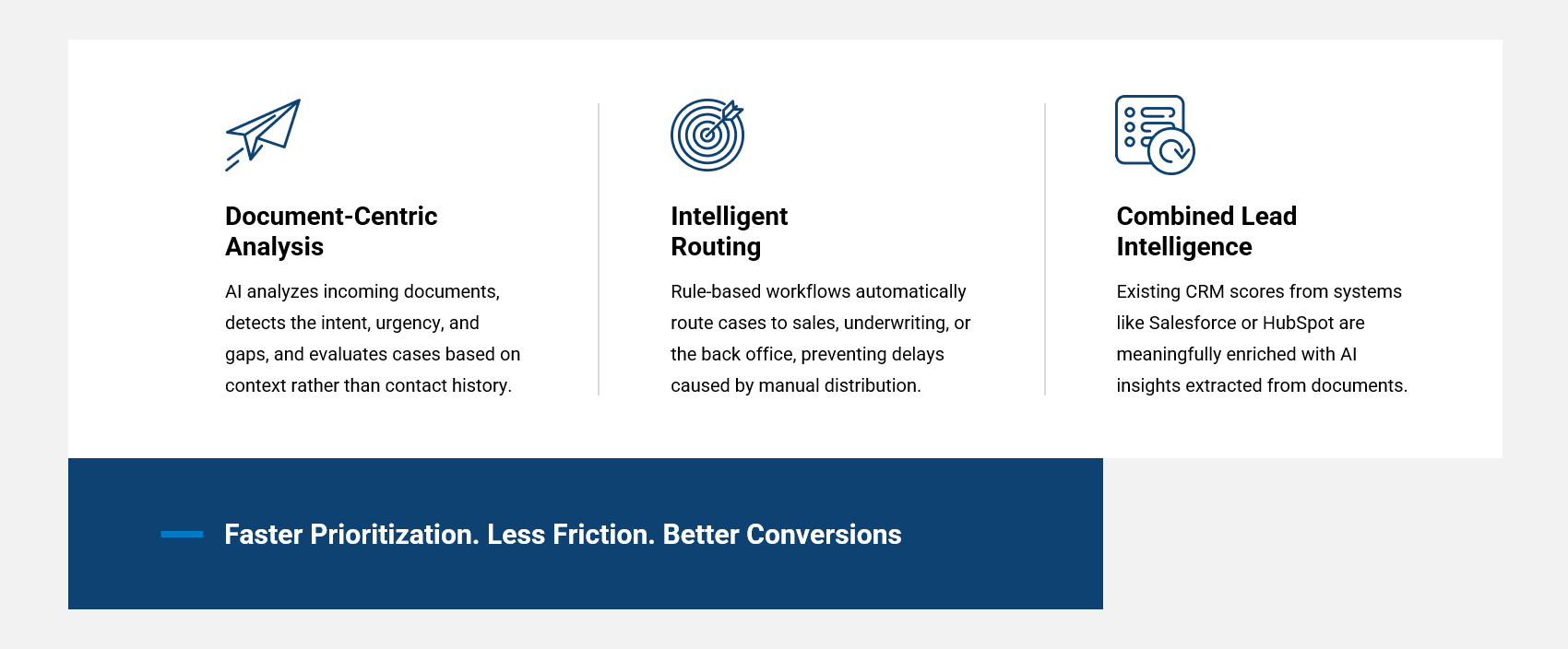
In practice, AI-assisted lead qualification with Paperfly does not mean evaluating leads in the traditional CRM sense, but intelligently analysing incoming cases. AI reads documents and supporting materials, identifies the request, urgency and missing information, prioritises cases accordingly and automatically obtains missing data or documents.
Paperfly can also import existing lead scores from CRM systems such as Salesforce or HubSpot and combine them with document-centric AI insights.
Lead Routing & Intelligent Workflow Orchestration
In modern insurance sales, manual lead forwarding is often a bottleneck: leads remain uncoordinated, important information is lost and average processing time increases significantly.
Sales Team Lead: „Ich will, dass keine Leads liegen bleiben und Zuweisungen nachvollziehbar und regelbasiert erfolgen.“
Manual vs. Automated Lead Routing
| Process Aspect | Manual | Automated | Benefit |
|---|---|---|---|
| Lead Assignment | Team decides ad hoc | Automatic assignment based on score or document criteria | ~60% faster |
| Error Rate | High (duplicates, incorrect teams) | Minimal, rule-based checks | ~80% fewer errors |
| Transparency / Traceability | Limited, Excel/CRM | Fully logged | 100% auditable |
| Processing Time | 2–5 Tage pro Lead | Hours to just a few minutes | 50–70 % schneller |
Identity Verification & Compliance
In the lead-to-policy process, digital identity verification is a key component for meeting regulatory requirements while also shortening completion times. Insurers must ensure that every decision, from lead qualification through to policy issuance, is documented in a GDPR-compliant, traceable and audit-ready manner.
Head of Compliance: „I need audit-ready evidence, digital audit trails and automated documentation that minimises regulatory risks.“
Compliance Criteria in the Lead-to-Policy Workflow
- GDPR-Compliant Data Processing: All process steps are logged automatically. The result is continuous, audit-ready documentation with 100% auditability.
- Identity Verification (KYC): Identities are verified digitally, for example via eID or wallet ID, as well as methods commonly used in the German market such as VideoIdent and BankIdent. Checks are completed faster, more consistently and without manual sources of error.
- Signatures & Approvals: Digital signatures are integrated directly into the workflow. Approvals are completed without media breaks and in an audit-ready manner, without sending PDFs or requiring manual rework.
- Risk Management & Documentation: Rule-based checks are applied automatically and documented in the audit log. Compliance risks can be identified early and systematically minimised.
- Archiving: Documents are archived digitally in the cloud. Review and audit records remain complete, traceable and available at all times.
ROI & Efficiency Measurement in Lead-to-Policy
Introducing an automated lead-to-policy workflow enables insurers to measurably improve efficiency across the entire sales and policy issuance journey.
KPIs for Measuring Efficiency
| KPI | Manual / Old | Digital / New | Effect / ROI |
|---|---|---|---|
| Conversion Rate | 15-25% | 30-50% | Up to +25 pp increase |
| Average Completion Time | 5-11 days | 1-2 days | 75-85% faster processing |
| Back-Office Effort | High manual processing effort | Automated handovers & checks | 50-75% fewer internal resources |
| Error Rate & Compliance | Frequent manual rework | Automated checks & audit log | Minimised risk, audit-ready |
Measurement Framework: Period: 4-8 months · Population: leads and new business in the retail/SME segment · Method: before/after matching for each process step (lead qualification, routing, underwriting, policy issuance) · Data sources: CRM, workflow logs, e-signature logs, DMS · Reporting: median + P90 + percentage change.
CFO: „I want clear visibility into how automation reduces OPEX, increases conversion and measurably shortens completion time.“
Mini How-To for KPI Monitoring:
- Define KPIs for Conversion, processing time and back-office effort.
- Capture Baseline Data from existing processes.
- Automated Workflows and digital checks.
- Measure KPIs Continuously.
- Compare Target and Actual Values, identify bottlenecks and optimise continuously.
Use Case: Automated Lead-to-Policy Processes at a Large Insurer
Challenge
A leading German insurer faced long completion times for new policies and high levels of manual effort in the back office. Some leads were processed multiple times or forwarded with delays, resulting in low conversion and dissatisfied customers.
Solution
Implementation of a digital lead-to-policy workflow with:
- AI-Based Lead Qualification: Automatic identification and prioritisation of the most promising prospects based on initial data and documents.
- Automated Routing: Leads are routed directly to the responsible sales and underwriting teams.
- Compliance & Audit Log: All steps documented in compliance with GDPR, including identity verification and approvals
Digitalisation Before/After
| Metric | Before | After | Improvement |
|---|---|---|---|
| Lead Processing Time | 3 days | 4 hours | -85 % |
| Back-Office Effort | 20 hrs. / week | 6 hrs. / week | -70 % |
| Conversion Rate | 18 % | 28 % | +10 pp |
| Customer Satisfaction | 72 % | 85 % | +13 pp |
Measurement Framework: Period: 3-6 months · Population: new customer leads (exclusive agency/broker + online) · Method: pre-/post-go-live comparison of processing times and handovers · Data sources: lead-scoring logs, routing logs, underwriting workflows, DMS, CSAT survey · Reporting: median + P75 + relative efficiency gains.
Through end-to-end automation, the insurer was able not only to make internal processes significantly more efficient, but also to increase conversion and improve customer satisfaction.
The combination of AI, workflow automation and document workflows is becoming a key lever for scalable sales.
Conclusion and Strategic Perspective: Scalable Sales
Automated lead-to-policy processes are not only an efficiency driver in day-to-day operations, but also enable insurers to scale their sales activities sustainably.
At the same time, insurers benefit from greater pipeline transparency, faster completion times and higher conversion rates.
Frequently Asked Questions (FAQ): Lead-to-Policy in Insurance
Why Is the Lead-to-Policy Workflow a Game Changer for Insurance Sales?
The lead-to-policy workflow transforms insurance sales by automating the entire process from lead generation through to final policy issuance. This significantly shortens completion times, reduces manual effort and increases conversion rates while maintaining compliance.
Which KPIs Should Be Measured to Determine ROI?
Important KPIs include lead conversion rate, average completion time, back-office effort, error rate and customer satisfaction. They show how automation affects efficiency, speed and revenue and help insurers assess the specific return on investment (ROI) of their digital lead-to-policy processes.
How Can Paperfly Features Accelerate Policy Issuance?
Paperfly centralises and automates workflows between sales, underwriting and the back office, while enabling digital signatures and identity verification. AI supports policy issuance by automatically reading, classifying and checking incoming documents for completeness, thereby triggering the next steps in the workflow. This reduces follow-up queries and enables policies to be completed significantly faster and in an audit-ready manner.
How Can Compliance Be Integrated into Automated Workflows?
Compliance is supported through rule-based checks, GDPR-compliant data handling, audit trails and audit-ready archiving. Digital workflows enable complete documentation of every step, reduce risks and ensure that decisions within the lead-to-policy process remain traceable and auditable.
Can AI Help with Lead Scoring?
Yes. AI can prioritise leads by analysing historical data, submitted documents, captured form data, for example from a QuickForm, and relevant risk parameters. This allows it to identify early which cases are particularly relevant or urgent. Manual effort is significantly reduced, allowing sales teams to focus on high-value leads, with measurably higher conversion.
Back to the Overview: Digital Sales Journeys (TAA): Overview, Introduction and Series StarterMini Glossary: Key Terms in the Lead-to-Policy Process
Lead-to-Policy Workflow = The end-to-end digital process in the insurance industry, from lead generation through qualification, risk assessment and routing to final policy issuance and archiving.
Lead Qualification = The process of automatically assessing and prioritising leads based on defined criteria, such as potential and urgency, in order to make sales more efficient.
Automated Routing = The automatic routing of leads and documents to the responsible departments or employees based on predefined criteria, in order to minimise delays and accelerate processing.
Identity Verification = Automated verification of a customer's identity in order to meet regulatory requirements such as KYC (Know Your Customer) and minimise compliance risks.
Compliance Audit Trail = A complete digital record of every step in the workflow that supports compliance with data protection and regulatory requirements.
Source: https://www.gdv.de/de/zahlen-und-fakten/digitalisierung