

Imagine a small trades business looking to take out commercial liability insurance. In the past, this meant filling in forms, entering activities and turnover, submitting supporting documents by post or PDF, and waiting for follow-up questions. By the time the application had been reviewed and the policy issued, several weeks had often passed.
This article shows how insurers successfully use online completion journeys (TAA), reduce time to policy and combine self-service with hybrid journeys at scale, including practical use cases with measurable results.
TAA (Pricing, Quotation, Completion) describes the end-to-end digital sales process from risk pricing and quotation through to legally binding completion. This transformation is not a future scenario: digital end-to-end journeys are becoming the scalable infrastructure of insurance distribution.
Series: Digital Sales Journeys (TAA) for Insurance
-
Part 1/4 - Digital Sales Journeys (TAA) for Insurance: Faster to Policy
Overview: How TAA journeys combine self-service and hybrid journeys at scale, including KPIs and success factors. -
Part 2/4 - Lead-to-Policy: Automated Workflows for Faster Policy Issuance
End to end from lead capture through routing and underwriting to policy issuance: fewer handovers and shorter processing times. -
Part 3/4 - Digital Go-to-Market for Insurance Products: Launch Faster
Manage versioning, approvals, audit trails and signatures centrally: go live faster and stay consistent across all channels. -
Part 4/4 - Digital Completion Times in Insurance: From Days to Minutes
Measurably reduce time to policy through clear journeys, automation and centralised documents: conversion and ROI.
What to Expect in This Article:
- Why Digital Completion & Sales Journeys Matter Today
- Modern Online Completion Journeys (TAA): The New Benchmark in Distribution Models
- End-to-End Workflows: Efficient Journeys from Lead to Policy Issuance
- Digital Workflows & Interfaces: Ensuring Efficiency and Scalability
- Self-Service for Policy Issuance: Increasing Efficiency and Customer Satisfaction
- Compliance from the Start: Digital Journeys with Audit Trails
- KPIs & Success Factors: How Insurers Measure Digital Completion Journeys
- Sales Success Example: Online Completion Journeys in Action
- Conclusion: Efficiency, Personalisation & Smart Sales Journeys
- Digital Completion Journeys: Practical Answers for Decision-Makers (FAQ)
Why Digital Completion and Sales Journeys Matter Today
Digital completion journeys are automated sales and policy issuance processes that extend from pricing and data validation through to e-signature.
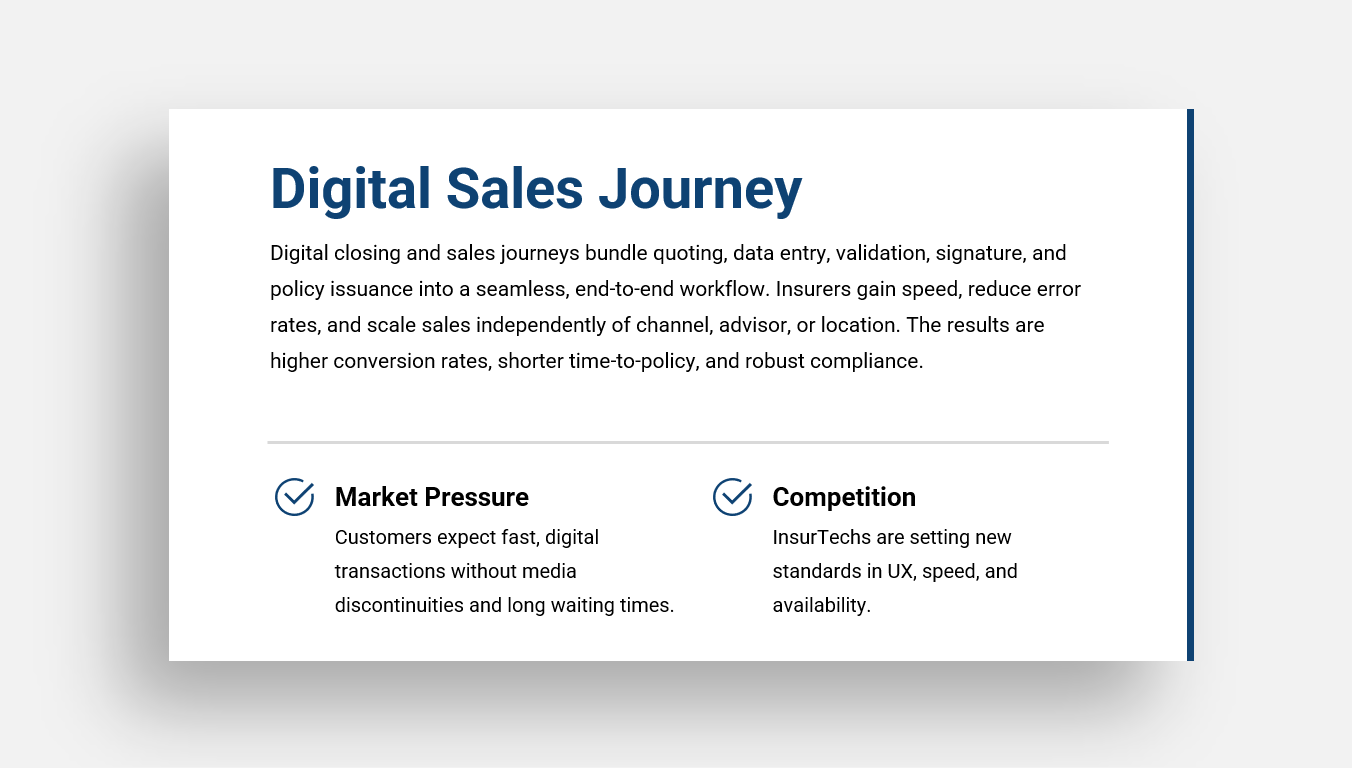
The demands placed on insurers have changed dramatically in recent years. Customers expect fast, transparent and digitally guided completion processes that can still include personal support, while functioning technically independently of any individual adviser.
What Does This Mean in Practice for Policy Issuance, Conversion Rates and Processing Times?
This Is Exactly What the Before/After Analysis Shows:
| Phase | Before (Traditional) | After (Digital) | Benefit / KPI |
|---|---|---|---|
| Customer Enquiry | Phone / email, manual data capture | Self-service, automatic validation | 50–70 % Zeitersparnis |
| Needs Analysis | Personal consultation, PDF checklists | Guided digital journey, AI-assisted analysis | Error rate ↓ 30% |
| Quotation | Manual calculation, email back-and-forth | Digital forms + automated PDFs | Conversion rate ↑ 25% |
| Contract Completion | Physical signature, postal delivery | Digital signature, immediate policy availability | Time to policy ↓ 65% |
| Audit Trail & Suitability Documentation | Manual, filed in folders | Automated audit trail system | Compliance 100% |
| Follow-Up / Upselling | Phone, follow-up email | Digital offers, reminders, AI personalisation | Customer retention ↑ 20% |
Measurement Framework: Period: 4-8 months · Population: SME policies (liability/property) · Method: before/after matching · Data sources: forms logs, DMS, e-signature, CRM · Reporting: median + P90
Self-service in insurance distribution enables customers or distribution partners to complete digital journeys independently, through to policy issuance. This development does not lead to more isolated solutions, but to a new distribution standard: digital sales journeys as scalable distribution infrastructure*.
*Digital distribution infrastructure connects pricing, risk, signatures, compliance and policy issuance in a scalable sales workflow.
Digital Completion Journey Without an End-to-End Workflow
Problem: Insurers digitalise individual steps, such as forms and signatures, but not the overall process.
Cause: Fragmented systems, manual handovers and missing end-to-end orchestration.
Consequence: Long time to policy, high error rates and increasing compliance risks despite a 'digital' appearance.
Modern Online Completion Journeys (TAA): The New Benchmark in Distribution Models
Modern digital sales journeys combine guided journeys, self-service modules and automated decisions to accelerate policy issuance and sales across channels. This creates scalable processes for brokers, sales teams, partners and self-service, independently of any individual intermediary.
Comparison: Traditional Sales vs. Modern Digital Journeys: Efficiency, Speed and Conversion Rates at a Glance
To understand the new benchmark, it is worth looking at the difference between traditional sales paths and scalable digital journeys.
| Characteristic | Traditional Sales | Modern Digital Journeys | Benefit / ROI Potential |
|---|---|---|---|
| Customer Guidance | Face-to-face, paper or simple PDF forms | Guided journeys, self-service | Lower abandonment rate, higher conversion |
| Completion Time | Days to weeks | Minutes to hours | Faster time to policy |
| Data Integration | Fragmented, manual | Centralised, automated | Better basis for decisions, fewer errors |
| Compliance | Checked retrospectively | Integrated IDD/GDPR checks | Reduced liability risk |
The difference lies less in the channel than in the infrastructure. The adviser is not being replaced; instead, the process is made scalable across channels, audit-ready and automated.
The Adviser Does Not Scale. The Process Does.Further Reading (End to End): Lead-to-Policy: Automated Routing, Underwriting and Policy Issuance
End-to-End Workflows: Efficient Journeys from Lead to Policy Issuance
Digital completion journeys have evolved from simple online forms into fully integrated end-to-end workflows that extend from lead capture and risk assessment through to policy issuance. Sales, underwriting and service processes are seamlessly connected, including structured data capture, automated needs analysis and policy completion.
Go-to-Market in Record Time: Launch New Insurance Products Faster
The successful market launch of new insurance products now depends heavily on digital go-to-market processes. Insurers can manage product definition, pricing and sales through flexible digital workflows, significantly reducing time and costs.
Through This End-to-End Digitalisation of the Go-to-Market Journey, Insurers Can:
Digital Sales Journeys Are Becoming the Core of Product Distribution, Not Just an Add-On.
Digital Workflows & Interfaces: Ensuring Efficiency and Scalability
The technological foundation of modern digital sales journeys is an orchestrated interplay of connected digital workflows. Modern platforms for digital business processes, such as Paperfly, manage workflows dynamically and give insurers the flexibility to respond quickly to new regulatory requirements.
Incidentally: Digital workflows can be connected directly to common policy administration and broker systems. Examples include Guidewire and Acturis, as well as systems commonly used in the German insurance market such as msg-NOVA and the VHV broker portal.
Seamless Document Management in the Digital Customer Journey
In many insurance processes, missing or delayed documents are one of the biggest bottlenecks in application and claims handling. Modern platforms show what end-to-end digital document requests look like today: prospects or distribution partners upload evidence directly, validations run automatically and workflows trigger subsequent steps. Case handlers only intervene when it is genuinely necessary.
The Result Is a Measurably Faster Completion Process and an Audit-Ready Audit Trail.
Before/After: Digital Document Requests in Insurance
| Process Step | Before: PDF & Email | After: Digital Document Request |
|---|---|---|
| Request for Missing Documents | Email from the case handler, no visibility over receipt | Automated workflow: web link for customers, status is tracked |
| Upload / Submission | Email attachments, often in the wrong format | Direct upload with format and completeness checks |
| Validation | Manual review with high effort | Rule-based validation, automatic case assignment |
| Filing in the DMS | Manual filing, high error rate | Automatic archiving including metadata |
| Compliance | Inconsistent, often maintained manually | Complete, version-controlled and immutable |
Digital Documentation & Signatures: Efficiency and Compliance in One Workflow
Online completion journeys (TAA) require more than just digital forms: what matters is machine-readable, audit-ready documentation of all sales events, combined with legally binding electronic signatures in accordance with eIDAS.
Broker Journeys Without Media Breaks for Faster Policy Issuance
The digitalisation of broker interfaces is also a key lever for creating completion journeys without media breaks and scalable sales processes. Broker processes are integrated directly into the digital customer journey.
Once the platform and interfaces are in place, the greatest growth lever emerges: self-service is no longer an additional channel, but a multiplier of overall sales performance.
Paperfly as the Orchestrator of End-to-End Digital Sales Journeys
Paperfly operates where digital sales journeys often fail: at media breaks between forms, review, signature and archiving. The platform orchestrates pricing, data capture, signature, audit trail and policy issuance in a single workflow, without adding complexity to the IT landscape.
Insurers reduce manual handovers, increase the First-Time-Right rate and achieve scalable time-to-policy performance.
Self-Service for Policy Issuance: Increasing Efficiency and Customer Satisfaction
Self-service is not a nice-to-have, but a central component of modern sales and service strategies. It meets customer expectations for speed and availability and makes insurance distribution more efficient and scalable.
Time to Policy Halved: Self-Service Success at a Mid-Sized Commercial Insurer
Where Processes Stalled:
- Long Processing Times for policies for small and medium-sized enterprises (SMEs).
- High Effort for manual review and document management.
- Many Follow-Up Queries from customers who do not understand the processes.
- Risk of Errors in data validation and compliance with regulatory requirements (IDD, GDPR).
How the Obstacles Were Overcome:
- Introduction of a Self-Service Journey with digital forms that perform field validations directly during completion.
- Validation for Required Fields, plausibility checks and immediate feedback to the customer.
- Electronic Signatures for legally valid completion processes.
- Hybrid Fallback: In complex cases or when uncertainty arises, customers can be seamlessly transferred to an adviser.
- Automated Workflows for documentation, audit trails and internal notifications.
Measurable Impact & Results:
| KPI | Before | After | Effect |
|---|---|---|---|
| Time-to-Policy | 7 days | 3.5 days | -50 % |
| First-Time-Right (FTR)* | 68 % | 92 % | +24 points |
| Support Tickets / Month | 120 | 65 | -46 % |
| Compliance Check Processing Time | 2 days | 0.5 days | -75 % |
Measurement Framework: Period: 4-6 months · Population: SME policies (liability/property) · Method: before/after matching · Data sources: forms logs, DMS, e-signature, CRM, support tickets · Reporting: median + P90 + percentage change *First-Time-Right means that an insurance application can be processed completely, compliantly and without follow-up queries on the first pass.
However, as Automation Increases, One Central Requirement Becomes More Important: compliance must be ensured through workflows, not through downstream manual checks.
Further Reading (Business Impact): Digital Completion Times - Measurably Improve Time to Policy, Conversion and ROICompliance from the Start: Digital Journeys with Audit Trails
The increasing digitalisation of insurance distribution does not make compliance simpler, but requires insurers to integrate regulatory requirements such as IDD, GDPR and the EU-wide Digital Operational Resilience Act (DORA) into digital processes from the outset.
Digital customer journeys provide the opportunity to document mandatory checks automatically and comprehensively, both for internal quality assurance and for external reviews by supervisory authorities.
By Integrating Audit Trails and Automated Checks, Insurers Can:
Compliance in Digital Insurance Journeys
| Obligation / Regulation | Digital Implementation | Automation | Control / Evidence |
|---|---|---|---|
| IDD Advisory Documentation | Guided journeys, required fields | Required fields enforce complete documentation | Audit trail*, internal reports |
| GDPR / Data Protection | Encrypted customer data, digital consents | Consent check, automatic logging | Checksums, reporting |
| DORA | ICT risk management, resilience and internal process controls | Workflow-driven controls and resilience checks | Audit logs, process monitoring and evidence |
| e-Signatures & Document Workflows | Digital signature directly within the form | Automatic filing in the DMS, versioning | Complete traceability & compliance evidence |
IDD Art. 20/23 + GDPR Art. 5/30: Digital required fields and audited storage reduce liability risks by 50-70% and shorten review times in disputed cases from 3 hours to < 45 minutes.
An audit trail is a tamper-resistant record of all process and signature events that provides verifiable evidence and compliance documentation.
Examples of 'If → Then' Logic in a Digital Sales Workflow
- If documents or information are missing, → then trigger an automatic follow-up request before completion.
- If risk thresholds are exceeded, → then route the case to underwriting.
- If abandonment is detected, → then trigger a reminder or hybrid fallback to an adviser.
KPIs & Success Factors: How Insurers Measure Digital Completion Journeys
Once the foundations are in place, technology changes not only speed, but also decision-making in underwriting, risk and pricing. Measuring the right KPIs is essential for assessing the success of digital completion and policy issuance processes and identifying opportunities for optimisation.
In addition, EPAM (2022): Insurance Digitalization Benchmark - Data Quality in Underwriting & Policy Issuance points out that incorrect or incomplete risk data can significantly extend processing times in policy issuance and underwriting.
| Cost Category | Traditional | Digital |
|---|---|---|
| Policy Issuance Costs / Case | 40–120 € | 12–30 € |
| Follow-Up Query Costs | 18–40 € / Fall | < €5 / case |
| Compliance Review Costs | 1–3 h Aufwand | < 45 min |
The effects are visible not only in speed, but also in measurably lower policy issuance and compliance costs per case.
Source: Deloitte (2023); EPAM (2022)
Sales Success Example: Online Completion Journeys in Action
Digital completion journeys demonstrate their impact in scalable sales processes across multiple channels (brokers, exclusive agency sales, a common distribution model in the German insurance market, partner business and self-service). The result: First-Time-Right (FTR) instead of follow-up queries, measurably better time to policy and audit-ready policy issuance out of the box.
Vorher–Nachher Case Study: Time-to-Policy im Gewerbe-Segment (KMU)
Insurers that implement digital end-to-end journeys report dramatically reduced processing times: the classic time-to-policy indicator shows how quickly an application is completed from submission through to policy issuance.
Digital Impact: Policy Issuance in Hours Rather Than Days
| Process Area | Starting Point 'Before' | Digital Solution | Result 'After' | KPIs |
|---|---|---|---|---|
| Application Intake | Paper forms, post, fax | Digital forms with online upload | Immediate digital processing, no media breaks | Time to policy: 5 days → 48 hours |
| Validation & Review | Manual, repeated follow-up queries | Automated validation + review routines | Fewer follow-up queries, faster approval | First-Time-Right: 65 % → 92 % |
| Signature / Completion | In-person appointment required | E-signature, hybrid fallback | Completion online or in person, flexibly | Conversion rate: 78% → 91% |
| Documentation & Audit | Manually archived, compliance risks | Digital DMS + audit trail | Complete documentation, compliant with regulatory requirements | Review effort: 3 hours → 0.5 hours |
Measurement Framework: Period: 6 months · Population: commercial policies (basic SME products) · Method: pre-/post-go-live matching · Data sources: QuickForm logs, DMS, e-signature, CRM · Reporting: median + P90
Self-service therefore not only accelerates the customer experience, but also increases completion capacity without additional FTEs (Full-Time Equivalents) while reducing compliance risks at the same time.
Conclusion: Efficiency, Personalisation & Smart Sales Journeys
The insurance industry is undergoing profound transformation. Technologies such as artificial intelligence (AI), real-time data analysis and dynamic personalisation are significantly advancing efficiency and scalability in policy issuance and sales.
Start a Pilot Now: With Measurable Results
Compare your existing process directly with an end-to-end digital journey, from application through to policy issuance. Paperfly makes differences in speed, follow-up queries and media breaks immediately visible.
Digital Completion Journeys: Practical Answers for Decision-Makers (FAQ)
Why Are Digital Sales Journeys (TAA) Becoming a Competitive Factor for Insurers?
Digital sales journeys connect pricing, quotation and completion in an end-to-end automated workflow. This allows insurers to significantly reduce time to policy, lower manual review effort and increase conversion rates. At the same time, integrated audit trails and validations support regulatory requirements such as the IDD (Insurance Distribution Directive) and GDPR.
How Do Digital Completion Journeys Work End to End?
Digital end-to-end completion journeys cover every step from lead capture and structured risk data collection through pricing/coverage logic and quotation generation to legally binding, digitally signed policy completion with audit-ready archiving.
How Do Digital Journeys Meet IDD Requirements?
Digital sales journeys support IDD requirements (EU rules for insurance distribution) through required fields, automated suitability checks and audit trails. AI-assisted validation and e-signature workflows document every step in an audit-ready manner and reduce liability risks by 50-70%.
How Can Self-Service Accelerate Sales?
Self-service portals enable customers to request quotations, complete forms and take out policies digitally on their own. This reduces support enquiries, shortens time to policy and allows sales teams to focus on additional products while the digital journey continues seamlessly.
What Role Does Hybrid Sales / a Hybrid Journey Play?
Hybrid sales use digital customer journeys that can be supplemented by advisers when needed, while the process remains fully digital and audit-ready. This helps customers build trust while digital processes support efficiency and compliance, combining best practices from personal advice and digital automation.
How Can Time to Policy Be Reduced?
Time to policy can be reduced significantly through digital forms, validation, digital signatures and automated workflows, often by up to 65%. Every step from quotation to policy creation is automated, enabling insurers to work more efficiently and customers to receive policies faster.
How Is Regulatory Documentation Integrated Efficiently?
Regulatory documentation is created automatically through audit trails, stored in an audit-ready manner and exported when required. This allows insurers to fulfil mandatory information requirements without manual effort while demonstrating compliance with IDD, GDPR and internal policies.
What Is Digital Policy Issuance?
Digital policy issuance covers the automated creation, signing and archiving of insurance contracts, including all regulatory evidence. It is the fully automated online completion process for an insurance policy, including risk assessment, signature and archiving.
Mini Glossary: Key Terms in Digital Completion Journeys
TAA (Pricing-Quotation-Completion) = End-to-end digital sales process from risk assessment through to policy issuance.
Time to Policy = The period from application to legally valid policy creation.
Audit Trail = Tamper-resistant record of all process and signature events.
First-Time-Right (FTR) = The proportion of cases completed without follow-up queries or rework.
Hybrid Journey = Combination of a digital completion journey and optional personal advice.
Sources:
Source 1: https://www.deloitte.com/de/de/Industries/insurance/research/digital-trust-in-insurance.html
Source 2: https://www.epam.com/content/dam/epam/campaigns/digital-modernization-in-the-insurance-industry/digital_modernization_in_the_insurance_industry.pdf