

From days to minutes: this is what a standard insurance completion process could look like in the future. Instead of piles of paper, waiting times and back-and-forth between different channels, customers now experience an end-to-end digital process that is clearly guided, automated and transparent. The policy is ready within hours, sources of error are minimised and sales teams gain valuable time.
In this article, we show in practical terms how digital customer journeys, automated workflows and centralised document workflows not only reduce processing times dramatically, but also support compliance, measurably increase ROI (return on investment) and significantly accelerate insurance sales.
Mini Benchmark
These figures apply broadly to digital completion journeys and increasingly to digital policy issuance workflows as well.
- Time to policy: 4-7 days → 30-180 min
- Error rate: 12-18% → 2-4%
- Conversion: 12-15% → 20-30%
Series: Digital Sales Journeys (TAA) for Insurance
-
Part 1/4 - Digital Sales Journeys (TAA) for Insurance: Faster to Policy
Overview: How TAA journeys combine self-service and hybrid journeys at scale, including KPIs and success factors. -
Part 2/4 - Lead-to-Policy: Automated Workflows for Faster Policy Issuance
End to end from lead capture through routing and underwriting to policy issuance: fewer handovers and shorter processing times. -
Part 3/4 - Digital Go-to-Market for Insurance Products: Launch Faster
Manage versioning, approvals, audit trails and signatures centrally: go live faster and stay consistent across all channels. -
Part 4/4 - Digital Completion Times in Insurance: From Days to Minutes
Measurably reduce time to policy through clear journeys, automation and centralised documents: conversion and ROI.
What to Expect in This Article:
- Challenges of Traditional Completion Processes
- How Do Digital Customer Journeys Reduce Completion Times in Insurance?
- How Automated Workflows Accelerate Approvals
- Manage Document Workflows Centrally
- ROI and Business Impact of Digital Completion Processes
- Implementation & Integration into Existing Systems
- Use Cases: How Do Digital Completion Processes Increase Efficiency and Conversion?
- Your Platform for Digital Completion Processes
- Conclusion: From Days to Minutes: Efficiency, Conversion and ROI
- Frequently Asked Questions About Digital Completion Processes (FAQ)
Challenges of Traditional Completion Processes
Traditional insurance completion processes are increasingly being replaced by digital application journeys and end-to-end customer journeys. Conventional processes suffer from long processing times, media breaks and a high susceptibility to errors. They often start digitally but end in paper-based processes, manual checks, multi-stage approvals and the dispatch of physical documents.
Comparison Table: Traditional vs. Digital Process
| Process Step | Traditional Completion | Digital Completion | KPI / Measurement Point |
|---|---|---|---|
| Application Submission | Paper or PDF form, email, post, fax | Digitally mapped within the customer journey | Duration: 1-3 days vs. minutes |
| Review & Approval | Manual, multiple approval stages | Automated workflow approvals | Zeitersparnis: 50–70 % |
| Signature | Physical signature, post or scan | Electronic signature, immediate policy issuance | Signature time: 1-3 days vs. < 1 hour |
| Document Management | Separate storage locations, duplicated work | Centralised repository, versioning | Error rate: high vs. low |
| Completion & Policy Issuance | Manual entry, media break | Automatic integration into the back office | Total processing time: 4-6 days vs. 24 hours |
Real KPI Values from Insurance Processes (Before Digitalisation)
- Error rate in incoming applications: 12-18%
- Follow-up query rate in sales/underwriting: 25-35%
- Average time to policy: 3-7 days*
- Share of incomplete documents: 30-45%
- Share of media breaks (PDF/email): 70-90%
*varies significantly by product line; figures here refer to retail and commercial lines with paper-based documents and manual approvals
KPI After Digitalisation (Digital Completion Journeys)
- Error rate: 2-4%
- Follow-up query rate: <10%
- Time to policy: 30-240 minutes
- Share of incomplete documents: <5%
- Share of media breaks: <5%
Started Digitally, Finished Analogue
Many insurers digitalise only individual steps of the completion journey: the form is online, but review, approval or signature still take place via PDF, email or paper.
Consequence: Media breaks, manual rework, high follow-up query rates and abandonment shortly before completion, despite a digital start.
How Do Digital Customer Journeys Reduce Completion Times in Insurance?
Digital customer journeys (digital completion journeys) reduce completion times in insurance from days to hours because application data is captured in a structured way, checked automatically and transferred directly into the workflow. Media breaks are eliminated, follow-up queries decrease and time to policy is measurably shortened.
The Digital Insurance Maturity study by Deloitte (source: Deloitte, 2024*) highlights that insurers with a higher degree of digitalisation not only achieve efficiency gains, but also significantly reduce error rates. Another lever for ROI.
Conversion & Journey Effects of Digital Application Journeys
- Conversion rate: +35-78%
- Abandonment rate: -40-60%
- First-Time-Right (complete submissions): +20-35 percentage points
- Customer input time: -50-70%
- Number of manually processed cases: -45-65%
Measurement Framework: Period: 3-6 months · Population: digital application journeys in commercial & retail business · Method: A/B comparison (traditional advice vs. digital hybrid journey) · Data sources: validation logs, IDD evidence, CRM leads → conversions, email/follow-up query rates · Reporting: conversion rates, abandonment rates, time to policy
From Days to Minutes: How Automated Workflows Accelerate Approvals
Automated approvals reduce processing time by up to 60%. The use of workflows also supports automated underwriting, allowing risk assessments to be completed faster and operating costs to be reduced.
Approval & Workflow Performance
- Waiting times for underwriting approvals: -55-70%
- Share of automated routine approvals: 40-65%
- Processing time per case: -30-60%
- Straight-through processing rate (depending on product and line of business): 10-40%
Automate Where There Is Routine. Decide Where Risk Arises.
Implementing Automated Workflow Approvals
Manage Document Workflows Centrally: Completeness, Quality & Compliance in the Process
How do documents enter the completion process in a complete, correct, versioned and auditable form? This is precisely where most delays, follow-up queries and errors occur today.
Document Review for Decision-Ready Documents
- Real-time completeness checks instead of manual review
- Automatic follow-up requests for missing documents
- Validation and plausibility rules directly within the process
- Seamless integration into completion journeys
Document Workflow Metrics
- Missing documents (before): 25-40%
- Missing documents (with digital workflow): <3%
- Follow-up queries due to document errors: -60 to -80%
- Time until complete documents are available:
- before: 2-4 days
- digital: <15 minutes
ROI and Business Impact of Digital Completion Processes
Digital completion processes create measurable economic value: shorter processing times reduce personnel costs and follow-up queries, lower error-related costs and increase conversion rates, all of which directly affect revenue and operational efficiency. Automation and digital application journeys improve both productivity and customer satisfaction.
- Key Point: Workflow automation not only reduces processing times, but also lowers error-related costs and OPEX (operational expenditure) per completed case.
- Practical Observation: Audit trail transparency facilitates internal and external audits and shortens audit cycles.
KPI Table: Which Metrics Should You Measure?
| KPI Description | Measurement Interval | Target Value (Example) |
|---|---|---|
| Number of Incoming Applications / Documents | monthly | 1.000 |
| Processing Time per Case (Minutes) | daily / monthly | 20–30 Min. → 8–18 Min. |
| Weighted Personnel Cost per Hour | annually | 50 € |
| Error Rate (e.g. Missing Documents) | monthly | 5 % → 1 % |
| Completed Policies / Qualified Leads | monthly | 10 % → 17,8 % |
Measurement Framework: Period: 6-12 months · Population: SME & retail completion journeys (TAA, pricing, quotation, application) · Method: before/after benchmark by product & channel (exclusive agency organisation (AO), a common distribution model in the German insurance market, brokers, partners, self-service) · Data sources: workflow logs, e-signature logs, CRM conversion rate, DMS/audit trail, underwriting approval steps · Exclusions: manual special cases, non-standard risk underwriting · Reporting: monthly (median, P90, percentage changes)
Financial Levers (OPEX, Conversion, Error-Related Costs)
- OPEX (Operational Expenditure) per Completed Case: -25-45%
- Error-Related Costs (Manual Corrections): -50-70%
- Time Saved per Case: 8-18 Minutes
- Time Saved in the Back Office per Month: 50-120 Hours in Total
- Payback Period for Digital Completion Journeys: 6-12 Weeks
- Additional Revenue Through Higher Conversion: +3-10% per Product Line
Audit-ready audit trails reduce rework during audits by 40-60%.
Implementation & Integration into Existing Systems
The technical integration of digital completion processes must be pragmatic, low-risk and measurable. What matters is a clearly defined pilot scope, clean system interfaces and a short ROI quick test that demonstrates early results.
Step-by-Step Integration Checklist (5-Week Pilot)
1. Scope & Ziele (KW0–KW1)
- Define pilot: product, region or distribution channel
- Target KPIs: processing time, conversion, error rate, integration effort
- Owner: Product Management / Sales
2. System-Check & Schnittstellen (KW1–KW2)
- Analysis of CRM (Customer Relationship Management), policy system, DMS (Document Management System), SSO (Single Sign-On), APIs (Application Programming Interfaces)
- Interface matrix: endpoints, data formats, authentication
- Owner: IT / Architecture
3. MVP Integration (Week 2)
- Core digital journey: application → validation → approval → signature → policy issuance
- Integrate Paperfly: workflow, DMS, e-signature (electronic signature)
- Owner: Product / Paperfly
4. Security & Compliance (KW2–KW3)
- GDPR, Germany's GoBD requirements for the proper keeping and retention of electronic books, records and documents, IDD and, for insurers operating under German supervision, requirements of Germany's Federal Financial Supervisory Authority (BaFin), audit trail
- Early alignment minimises rework
- Owner: Legal / Compliance
5. Technischer Pilot (KW3–KW5)
- Connections between Paperfly ↔ CRM/DMS/policy system
- Configure rules & escalations (e.g. straight-through processing)
- Owner: IT + Paperfly
Responsibilities and Rules
- Product Management: defines the pilot scope and target KPIs.
- IT Architecture: is responsible for interfaces and security requirements.
- Head of Compliance: assesses compliance with IDD and GDPR requirements and, where applicable in Germany, the supervisory requirements of Germany's Federal Financial Supervisory Authority (BaFin).
- Sales: provides feedback on conversion and field adoption.
- Required fields + validation rules → fewer follow-up queries.
- e-Signature for standard products → immediate policy issuance.
Use Cases: How Do Digital Completion Processes Increase Efficiency and Conversion in Insurance Sales?
Digital completion processes reduce media breaks, automate approvals, validate customer data at an early stage and centralise documents. Studies by the German Insurance Association (GDV) on the German insurance market (source: GDV, 2024*) and practical examples such as Zurich Insurance's digital agent advisory solution (source: Zurich Consultation 2025*) show:
Mini Use Case 1: Digital Completion Journey
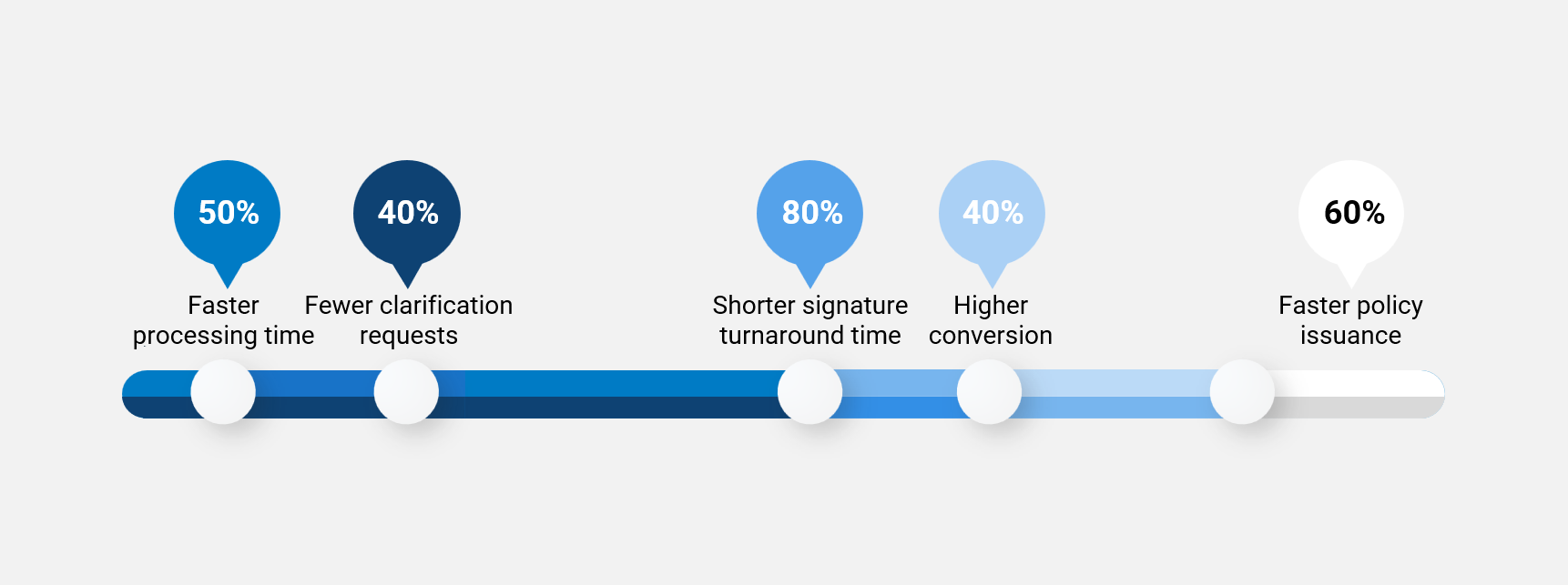
Processing Time: Before: 3-5 days / After: 30-90 minutes
Conversion Rate: Before: approx. 12-15% / After: +30-50% (digital funnel, fewer drop-offs)
Error Rate: Before: 18-22% / After: <5% (required fields, validation rules)
Before/After Benchmarks
- Processing time: 3-5 days → 30-90 minutes
- Missing required information: 25-40% → <5%
- Signature turnaround time: 1-3 days → <1 hour
- Follow-up query rate: 30-45% → <10%
- Policy issuance time: 2-4 days → under 24 hours
Measurement Framework: Period: 4-9 months · Population: digital completion journeys for SME/SOHO policies (liability, property, cyber) · Method: before/after benchmarking · Data sources: forms logs, DMS, e-signature, CRM, processor time tracking · Exclusions: special risks + manual underwriting cases · Reporting: monthly (median + P90, error rate, STP rate (Straight-Through Processing, fully automated completions), OPEX/case)
Mini Use Case 2: Mobile Advisory Solution
Mobility & Data Quality: Before: paper forms, duplicate entries / After: digital capture → direct system transfer
Advisory Time per Customer: Before: 60-90 min. / After: 35-50 min.
Follow-Up Query Volume: Before: high (missing documents) / After: -40-60% (digital documents + checklists)
Mini Use Case 3: Automated Approval & Document Review
Waiting Times Between Departments: Before: 24-72 hours / After: real-time approvals / rules
Error-Related Costs: Before: high (media breaks, manual scans) / After: -50-70% thanks to document repository + audit trail
Customer Experience: Before: non-transparent / After: clear status, automated notifications
Paperfly: Your Platform for Digital Completion Processes
Paperfly is a SaaS (Software-as-a-Service) platform that enables insurers to map digital completion processes efficiently, securely and in a compliant manner. The platform centralises application data, automates approvals and integrates electronic signatures.
Core Features at a Glance
| Feature | Description |
|---|---|
| Digital Application Journey & Workflow | Automated processing of applications, including escalation and routing logic. Fully configurable workflows without programming (no-code) provide clear process guidance for sales teams and customers. |
| Electronic Signature (eIDAS-Compliant) | Electronic signatures (SES, AES, QES) with an integrated audit trail. Completion and policy issuance take place immediately and without media breaks. |
| Document Workflow & Audit Trail | Centralised versioning, complete audit trails and automatic document filing. Missing documents are requested specifically via Document Collection, in an audit-ready and traceable manner. |
| Validation & Document Logic | Completeness and plausibility checks, validation of customer input and optional identity verification. Errors are detected automatically and follow-up requests are triggered immediately. |
| Integration & Automation | Seamless connection to CRM, policy or DMS systems. Documents, statuses and decisions are passed automatically to downstream systems. |
Conclusion: From Days to Minutes: Efficiency, Conversion and ROI
Digital completion processes are already established practice for insurers seeking to increase efficiency, customer satisfaction and revenue. From automated application journeys and workflow approvals to centralised document management, processing times can be reduced to hours, error rates significantly lowered and conversion rates increased by up to 78%.
Key Message: Organisations that consistently implement digital completion processes transform lengthy paper-based processes into high-speed workflows, benefiting customers, sales teams and overall business performance.
Frequently Asked Questions About Digital Completion Processes (FAQ)
How Long Does a Digital Insurance Completion Process Take?
A digital insurance completion process usually takes 24-48 hours. Digital processes replace traditional paper-based journeys, avoiding media breaks and minimising follow-up queries. Previously, processing could take several days; digitally, applications can be reviewed and approved significantly faster.
Are Electronic Signatures Legally Secure?
Electronic signatures are defined under eIDAS in three levels (SES, AES, QES) and can be used securely depending on the process, risk and legal requirements. Each level has its purpose: SES for simple, low-risk transactions, AES for enhanced security, and QES for cases requiring written form or involving a higher level of risk. It is important that insurers select the appropriate level based on their own risk management.
How Can Digital Workflows Be Implemented Quickly?
Digital workflows can be integrated step by step: analyse existing application journeys, digitalise core processes (validation, approval, signature, document management) and use SaaS tools such as Paperfly. Early pilot projects reduce risks and deliver measurable efficiency gains.
How Can I Measure Efficiency & ROI?
Efficiency and ROI in digital completion processes can be measured using KPIs such as processing times, conversion rates, error rates and cost savings. Benchmarking with before-and-after comparisons shows how process times, error-related costs and additional revenue can be quantified.
Which Completion Processes Are Best Suited to a First Pilot?
A suitable pilot for digital completion processes combines high volume with medium complexity and few special risks. Typical examples include household contents, liability or simple SME/SOHO policies. Time to policy, error rates and conversion can be measured quickly in these areas. Initial successes from the pilot can then be scaled to more complex lines of business and channels.
How Do I Ensure That Digital Completion Processes Comply with BaFin and IDD Requirements?
Compliance with BaFin and IDD requirements is supported through standardised advisory and completion journeys: required fields, IDD records, consents and product information are embedded directly in the workflow. An audit trail records every change in a traceable manner. Digital signatures, role-based permissions and GDPR-compliant data handling help ensure that completions are legally robust, audit-ready and transparent for both internal and external reviews.
Mini Glossary: Key Terms in Digital Completion Processes
Digital Completion Times = The period from receipt of the application to policy issuance in fully digital insurance processes.
Time to Policy = A metric for the duration between a complete application and final policy creation, including review, signature and filing.
First-Time-Right = The proportion of applications submitted completely and correctly without requiring rework.
Media Break = An interruption in a digital process caused by manual steps, paper forms or email-based handovers.
Straight-Through Processing = Fully automated processing of standard cases without manual intervention, based on defined rules.
Audit Trail = Complete, audit-ready documentation of all process steps, versions and decisions.
Head of Compliance = reviews compliance with IDD and BaFin requirements.
Sales = assesses conversion and completion time.
Sources:
https://www.gdv.de/gdv/medien/medieninformationen/versicherung-vertrieb-abschluesse-digital-181036
https://www.deloitte.com/de/de/industries/financial-services/research/digital-insurance-maturity-studie.html
https://www.gdv.de/gdv/themen/digitalisierung/versicherungsvertrieb-kann-von-digitalen-innovationen-profitieren--132014
https://www.deloittedigital.com/ch/de/work/mobile-consultation.html