

Imagine a new customer wanting to open a securities account: data is captured directly, forms are checked automatically and identities are validated through ID verification. This speed advantage is more than just added convenience for customers.
For banks, it means higher conversion, lower error rates and measurable ROI. Digital workflows do not just transform individual processes, but create a strategic competitive advantage.
This article provides practical insight into how banks digitalise internal processes, create seamless customer journeys and achieve measurable efficiency and cost gains through workflow automation.
Series: From Paper to Performance
-
Part 1/5 - From Paper to Performance: Why Banks Need End-to-End Digitalisation
Cost and risk drivers of paper-based processes, plus a roadmap for end-to-end workflows. -
Part 2/5 - PDF ≠ Digital: How Banks Can Finally Use PDFs Intelligently
Why 'saving a PDF' is not a process and how PDFs can become structured, verifiable data. -
Part 3/5 - Evidential Value of Digital Documents: Legally Robust Digital Processes in Banks
Evidential value, audit trails and signatures: what really matters for audit and regulatory robustness. -
Part 4/5 - Digital Competitiveness: How Banks Can Keep Pace in the Digital Market
The capabilities banks now need and the process metrics that make the difference measurable. -
Part 5/5 - Workflow Automation: Step by Step to a Paperless Process
How workflow automation creates robust process infrastructure: faster and compliant
What to Expect in This Article:
- Why Digital Competitiveness Is Critical for Banks
- Typical Pain Points in Analogue Processes
- Efficiency Gains Through Digital Workflows
- Seamless Customer Journeys as a Competitive Advantage
- Reference Case: Digital Securities Account Opening as a Competitive Lever
- Integrating Paperfly into Existing Systems
- ROI Perspective for Banks: Time Savings, Cost Effects & Measurable Value
- Compliance & Risk Reduction Through Digital Processes
- Practical Implementation of Digital Workflows in Banks
- Digital Workflows in Practice: Making Efficiency and Conversion Gains Visible
- Summary & Recommendations
- Questions (FAQ) on the Digital Competitiveness of Banks
Why Digital Competitiveness Is Critical for Banks
Competition in German retail banking is intensifying: according to McKinsey's 2025 'German Retail Banking Report', more than 70% of all new customer interactions in the German retail banking market are shifting into digital channels. Speed, error-free processes and personalised services are becoming critical differentiators.
Banks Should Become Part of Digital Ecosystems. This is not only about technology, but also about the ability to connect it with existing core banking systems.
Comparison: Digital Champions vs. Laggards in Banking
| Characteristic | Digital Champions | Laggards |
|---|---|---|
| Onboarding Time | < 5 minutes, fully digital | 1-3 days, manual documents |
| Error Rate | < 1% thanks to validation & automation | 8-12% due to manual input |
| Customer Satisfaction (NPS) | +45 points | < 10 points |
| Time to Market for New Products | Weeks | Months |
| Competitive Advantage | Speed, CX (Customer Experience), scalability | Process costs, risk & media breaks |
Measurement Framework: Period: 6-12 months, population: onboarding/account/securities account journeys, method: before/after (matching), data sources: workflow logs, CRM, NPS, cost centres, reporting: monthly (median, P90). Note: values are typical ranges from before/after comparisons in digitalisation projects; actual effects vary depending on process maturity and product.
Typical Pain Points in Analogue Processes
Analogue processes are no longer just an efficiency issue, but a competitive risk. While direct banks and FinTechs handle account or securities account openings in minutes, customers using paper-based journeys often wait several days for activation. Younger customer segments in particular are quick to switch providers in such situations.
Competitive Weaknesses of Analogue Processes:
- Long Time to Activate: With analogue journeys, five to seven days can pass between application and a usable account or securities account. Digital competitors often activate customers overnight and secure completions before the traditional process has even finished.
- High Abandonment and Switching Rates: Media breaks, paper forms and subsequent follow-up requests drive abandonment rates upwards. Digitally savvy customers in particular abandon processes or switch to providers offering fully digital onboarding.
- Limited Appeal to Younger Target Groups: Customers accustomed to digital self-service journeys perceive paper-based processes as outdated. This has a direct impact on Net Promoter Score, willingness to recommend and brand perception.
- Branch and Opening Hours as a Bottleneck: Analogue processes are often tied to branch opening hours. Digital players offer 24/7 onboarding and service, a clear advantage when competing for mobile, working customer segments.
Every Additional Application Creates More Paper, More Scanning Effort and More Manual Review.
Digital Workflows Scale Almost Linearly: This Enables Growth Without Further Burdening the Cost-Income Ratio.
Digital Workflows Do Not Just Resolve These Weaknesses Internally, but Directly Support Market Objectives: faster activation, lower abandonment rates, greater appeal to digital customer segments and more flexibility in pricing and product design.
Efficiency Gains Through Digital Workflows
Modern workflow automation, such as that enabled by Paperfly, does more than reduce internal effort. It determines how quickly products reach the market, how seamless the service experience is and how scalable a bank's business model becomes, in other words, genuine competitiveness.
Key Effects of Digital Workflows at a Glance & Their Impact on Market Position
| Effect / Metric | Analogue Process | Digital Workflow | Benefit for the Bank / Competitive Impact |
|---|---|---|---|
| Processing Time for Credit Decisions | 3-5 days | < 1 day | Faster lending decisions and higher customer satisfaction; a shorter time to yes increases conversion compared with competitors that have lengthy decision-making processes. |
| Error Rate in Forms & Data | 12-18% | 2-4% | Fewer follow-up queries and lower operating costs; fewer onboarding drop-offs and a more consistent customer experience across all channels. |
| Processing Time for Service Requests | 24-48 hours | 2-4 hours | More efficient customer service; service levels that can keep pace with digital competitors instead of losing customers to direct banks and FinTechs. |
| Compliance Checks & Audit Reporting | Manual, time-consuming | Automatic, complete | Reduced risk; resources shift from manual rework to market- and customer-focused projects (e.g. new digital products). |
| Cost per Case / Document | High | Low | Savings and better scalability; greater flexibility for competitive pricing and terms without sacrificing margins. |
Measurement Framework: Period: 6-12 months, population: onboarding/account/securities account journeys, method: before/after (matching), data sources: workflow logs, CRM, NPS, cost centres, reporting: monthly (median, P90)
Seamless Customer Journeys as a Competitive Advantage
Banks that still rely heavily on analogue processes lose up to 25% of potential customers during onboarding.
When opening an account or securities account using paper forms, customers often wait 5-7 days for activation. Digitally, they can complete everything in under 24 hours: the bank acquires customers faster and significantly reduces drop-offs.
Further KPI Comparison: Analogue vs. Digital Customer Journeys
- Onboarding Abandonment Rate: Analogue: 20-25% → Digital: 5-8%. Result: more customers successfully onboarded, higher revenue.
- Form Review & Error Correction: Analogue: manual and time-consuming → Digital: automatic, real-time validation. Result: fewer follow-up queries, lower error rates.
- Personalisation & Cross-Selling: Analogue: limited → Digital: data-driven, dynamic. Result: higher customer retention and better up- and cross-selling potential.
- Customer Satisfaction (NPS): Analogue: 60-65 → Digital: 75-80. Result: stronger image, higher recommendation rate.
Reference Case: Digital Securities Account Opening as a Competitive Lever
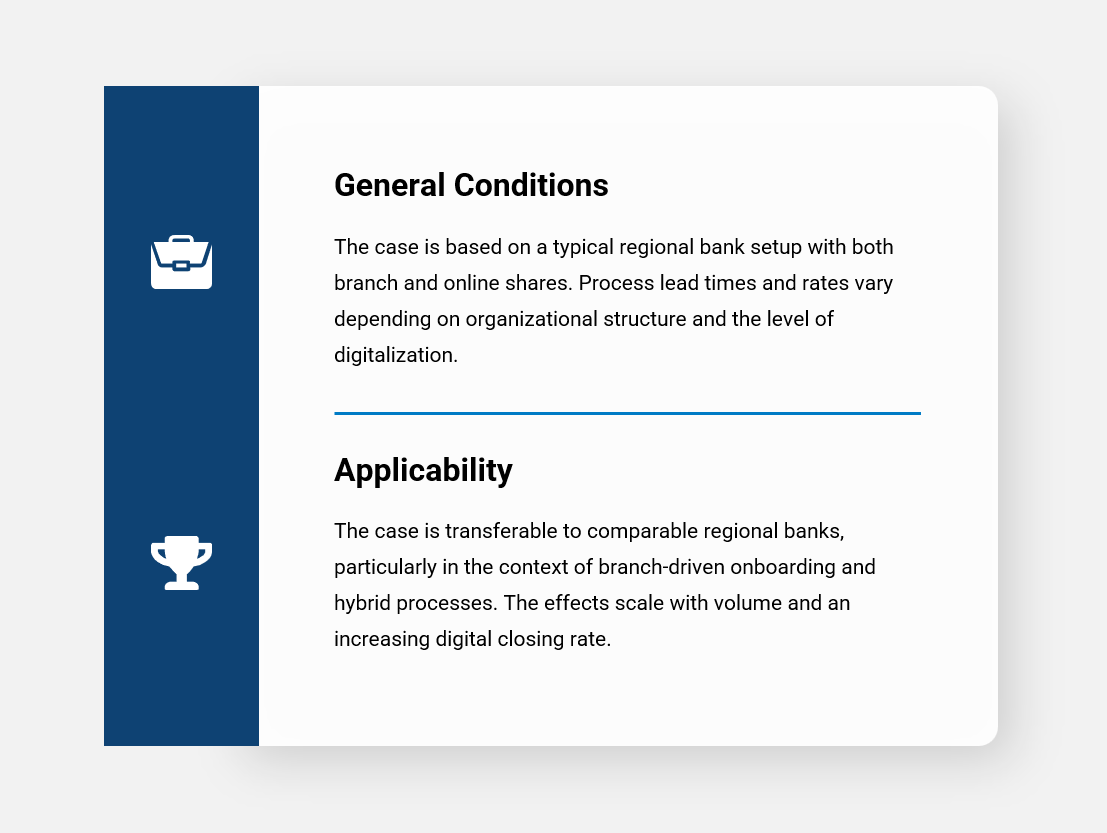
The following example shows how a traditional securities account opening process at a regional bank changes when it is converted from a paper-based procedure to an end-to-end digital workflow.
The figures are representative of many institutions with a strong branch focus and growing online business.
Starting Point (Before Digitalisation)
- Institution: regional bank with around 300,000 retail customers
- Process: securities account opening for retail customers (branch + online)
- Onboarding journey: combination of paper forms, PDFs and manual rework
- Media breaks: printing online forms, signing on paper, postal return and manual review
Selected Metrics in the Starting State
- Abandonment Rate in the online journey: approx. 35-40 %
- Time to Activate (from application to usable securities account): average 3-5 calendar days
- NPS of the onboarding journey: approx. +5
- Cross-Selling Rate within the first 6 months (additional products such as savings plans, instant-access savings accounts or credit cards): approx. 12 % of new customers
Implementation: End-to-End Digital Securities Account Opening with Paperfly
The bank converts the securities account opening process to an end-to-end digital workflow orchestrated through Paperfly:
- Digital Application Capture instead of PDF/paper: forms with real-time validation
- Automated KYC and AML Checks under the German Anti-Money Laundering Act (GwG), using connected services (e.g. eID procedures, sanctions lists, PEP checks)
- Electronic Signature (SES/AES/QES) directly within the journey, without media breaks
- Guided Follow-Up Request Processes (e.g. missing documents) via email/SMS with self-service upload
- Automated Transfer to Core Banking and Securities Systems including an audit trail
The Bank's Focus Is Explicitly Not Only on Efficiency, but Also on:
- Reducing the Abandonment Rate
- Shortening the Time to Activate
- Increasing the NPS in onboarding
- Increasing the Cross-Selling-Potenzials through clean data and a strong first impression
Measurement Framework: Period: 9 months · Population: all retail securities account openings (branch + online) · Method: before/after comparison · Data sources: workflow logs, CRM, customer satisfaction surveys, cost centre reporting.
What This Use Case Shows About Digital Competitiveness
This Is How You Improve Contribution Margin per Customer: a Clear Advantage in a Low-Margin Environment.
Integrating Paperfly into Existing Systems
The seamless integration of digital tools into existing banking processes is a key lever for efficiency and regulatory assurance. Paperfly provides a modular platform that enables customer journeys for banking customers to be mapped fully digitally and automated end to end.
Mini How-To for Decision-Makers:
- Analyse Existing Workflows: Identify bottlenecks and manual interfaces.
- Modular Integration: Model process steps as a pilot in Paperfly.
- Set Up KPI Monitoring: Measure time savings, abandonment rate and error rate.
- Scaling & Rollout: Implement successful pilot processes across departments.
ROI Perspective for Banks: Time Savings, Cost Effects & Measurable Value
Efficiency gains can be measured economically. Through automation and the use of AI, banks can realise significant revenue potential while reducing operating costs at the same time.
Example Calculation: Efficiency & Cost Savings per Document
| Metric | Analogue Process | Digital Process (e.g. Paperfly) | Benefit / ROI for the Bank |
|---|---|---|---|
| Processing Time per Document | 30 min-1 hour | 5-10 min | Zeitersparnis 70–80 %, schneller Cashflow |
| Error Rate / Rework | 5-10% | < 1% | Fewer corrections, lower costs |
| Staff Costs per Document | €15 | €2-3 | Einsparung 12–13 €, Skaleneffekte |
| Onboarding Processing Time | 5-7 days | < 24 hours | Faster customer activation, higher conversion |
| Pilot Project ROI Horizon | - | 3-6 months | Early benefits, measurable payback |
Compliance & Risk Reduction Through Digital Processes
Many banks in Germany still show significant weaknesses in KYC and AML (Anti-Money Laundering) processes. For banks operating in Germany, these processes are implemented, among other requirements, within the framework of the German Anti-Money Laundering Act (GwG). Digital workflows significantly reduce regulatory risks by standardising processes, minimising error rates and ensuring complete traceability of all actions.
Key Compliance Benefits of Digital Workflows:
Further Reading (Compliance): Evidential Value of Digital Documents in Banks: Signatures, Audit Trails and Audit ReadinessPractical Implementation of Digital Workflows in Banks
Implementing digital workflows requires a methodical approach to ensure efficiency gains, compliance assurance and high user acceptance.
This Is Exactly Where Paperfly Comes In: The platform is used by many institutions and provides proven best-practice workflows, regulatory-compliant standards and a clear roadmap. This turns what appears to be a major transformation task into a structured project with manageable effort and rapid results.
Process Map: Current State → Pilot Phase → Optimisation → Rollout
| Phase | Activities | Objectives / KPIs |
|---|---|---|
| Current State | Process mapping, document analysis, benchmarking | Make bottlenecks & sources of error visible |
| Pilot Phase | Test automated workflows in a selected area | Assess acceptance, measure initial efficiency gains |
| Optimisation | Adapt workflows, train users, integrate user feedback | Reduce error rates, shorten processing times |
| Rollout | Scale to additional products and departments | End-to-end digitalisation, realise ROI |
Digital Workflows in Practice: Making Efficiency and Conversion Gains Visible
Digital workflows demonstrate their value particularly clearly in standardised, recurring processes such as securities account openings or KYC checks. While analogue processes often take several days and are prone to errors, digital workflows deliver significant efficiency and conversion gains.
Lessons Learned & Best Practices:
- Start Pilot Projects on a Small Scale First: Test workflows in a selected product area before scaling.
- Use Automated Validation: Real-time checks prevent rework and reduce errors.
- Prioritise Customer Centricity: Seamless digital journeys reduce drop-offs and increase cross-selling potential.
- Plan Compliance Integration Early: Integrate audit trails, KYC/AML checks and eIDAS-compliant signatures from the outset.
Banks that use digital onboarding workflows significantly reduce drop-offs while increasing customer satisfaction at the same time.Further Reading (Strategy): Digital Competitiveness in Banks: Capabilities, KPI Set and Roadmap
Summary & Recommendations
Digital workflows and seamless customer journeys are now critical factors in banks' competitiveness. Efficiency gains, lower error rates, higher customer satisfaction and measurable ROI show that a strategic focus on process automation and digital tools such as Paperfly delivers direct economic benefits.
Step-by-Step Recommendation to Conclude:
- Analyse Processes (bottlenecks, media breaks and sources of error) and start a pilot project
- Coordinate Across Departments: Involve IT, specialist departments and compliance early
- Measure & Optimise Results: Implement KPI monitoring for processing times, error rates, conversion and NPS
- Plan Scaling: Transfer successful pilot processes to additional business areas.
Typical Objections. Short Answers.
- 'We Have No IT Capacity.' → Start als Pilot; IT bleibt informiert, Fachbereich leitet an.
- 'Compliance Will Slow Us Down.' → Audit trails + signatures + KYC/AML are modelled as control points in the workflow; less retrospective review, more standardisation.
- 'Our Processes Are Too Individual.' → Geeignet für standardisierte Strecken (Onboarding/KYC/Depot); Sonderfälle bleiben in manuellen Pfaden.
- 'ROI Is Difficult for Us to Demonstrate.' → A measurement framework + 3-5 core KPIs (time to activate, abandonment, error rate, OPEX/case, NPS) are sufficient for a robust before/after comparison.
Questions (FAQ) on the Digital Competitiveness of Banks
How Can Internal Banking Processes Be Digitalised Without Increasing Compliance Risks?
Internal banking processes can be digitalised safely when workflows include audit trails, eIDAS-compliant signatures and integrated KYC/AML checks from the outset. Pilot projects in clearly defined areas enable controlled automation, reduce risks and help ensure regulatory requirements continue to be met when scaling later.
Which KPIs Best Demonstrate the Success of Digital Workflows?
The success of digital workflows is reflected primarily in shorter processing times, lower error rates, higher onboarding conversion rates and rising customer satisfaction (NPS). In addition, operational cost savings and time to activate provide clear indicators of the efficiency, economic performance and competitiveness of digital banking processes.
What Typical Errors Occur When Digitalising Forms?
Typical errors in form digitalisation include missing required-field validation, incorrect mapping of PDF fields, media breaks caused by manual scanning and unclear user guidance. These weaknesses increase rework, extend processing times and raise the risk of drop-offs as well as compliance-relevant errors in the process.
How Quickly Does a Digital Workflow Solution Pay for Itself?
Digital workflow solutions often pay for themselves within a few months. The decisive factors are process volume, time savings and reduced error rates. Even moderate savings per document add up across thousands of monthly cases to significant OPEX reductions and a rapid return on investment.
How Can I Avoid Typical Implementation Errors?
Errors can be avoided by involving all specialist departments early, running pilot projects before full rollout, providing practical training, using feedback loops, deploying standardised applications such as Paperfly and optimising step by step based on KPIs.
Back to the Series: From Paper to Performance: End-to-End Digitalisation in Banks (Overview & Introduction)Mini Glossary: Digital Competitiveness of Banks
Digital Competitiveness = the ability to operate customer journeys quickly, with low error rates and in a compliance-ready manner, with measurable effects on conversion, NPS and OPEX.
Time to Activate = the period from customer application to a usable account or securities account opening; a key KPI for conversion and customer experience.
Straight-Through Processing (STP) = fully automated end-to-end processing of a process without manual intervention; increases scalability and reduces OPEX per case.
Onboarding Abandonment Rate = the proportion of customers who abandon an account or securities account opening before completion; a direct indicator of process quality and competitiveness.
Customer Journey = the totality of all customer touchpoints along a process (e.g. onboarding, service, completion); seamless journeys reduce drop-offs and increase cross-selling.
Cost-Income Ratio (CIR) = the ratio of operating costs to income; digital workflows influence CIR indirectly through lower OPEX and better economies of scale.
Audit Trail = complete logging of all process and document steps; a prerequisite for compliance, audit readiness and scalable automation.
KYC / AML = Know Your Customer and Anti-Money Laundering checks for identity and risk assessment; when digitally integrated, they reduce manual rework and regulatory risks.
Source: https://www.mckinsey.com/de/news/presse/2025-09-30-german-retail-banking-report-2025