

Imagine your bank's mailroom working like a highly intelligent employee who never gets tired, makes no mistakes and, of course within a clearly defined framework, can make complex decisions at the same time.
AI-supported mailroom processes make exactly this possible: They do not merely recognise text, but understand content and context, check documents for completeness and plausibility, and automatically route them into the appropriate specialist and workflow processes.
AI becomes a key driver of smart workflows, faster decisions and measurable ROI.
What to expect in this article:
- Why Mailroom Processes in Banks Need to Be Modernised
- From OCR to AI: Intelligent Document Processing for Banks
- How AI Agents Work in the Mailroom
- Seamlessly Connected: Integrating AI Agents
- Measurable Gains: Time, Cost & Performance with AI
- Audit-Ready: Reliable Compliance Support with AI Agents
- Roadmap to Automated Mailroom Processing with AI
- How AI Agents Transform Workflows in Banks
- Measuring AI Agent Success: Metrics, ROI and Optimisation Potential
- Conclusion & Outlook: Future-Ready Mailrooms
- Frequently Asked Questions (FAQ) About AI Mailrooms in Banks
Why Mailroom Processes in Banks Need to Be Modernised
Traditional mailroom processes in banks create significant processing effort because documents still often need to be reviewed, distributed and checked manually. Follow-up questions, media breaks and incomplete documents extend processing times and increase costs. AI-supported processes automate validation and routing, improving quality, speed and scalability.
Employees spend several hours a day on average on mailroom tasks alone: time that is then unavailable for value creation, customer service or compliance checks.
AI-Based Mailroom Processes Enable:
The combination of OCR technology and AI agents offers more than text recognition alone: it enables semantic analysis, contextual understanding and fraud detection.
Typical Anti-Pattern in Mailroom Processing
Problem: Documents are pre-sorted manually, often without clear rules or quality checks.
Cause: lack of standardisation and isolated departmental logic.
Consequence: high rates of follow-up questions, inconsistent processing quality and increasing compliance risks.
Comparison: Manual vs. AI-Supported Mailroom
| Feature | Manual Mailroom | AI-Supported Mailroom |
|---|---|---|
| Document Capture | Employees review physical documents | Automatic capture, including via scanner/OCR + AI |
| Classification | Manual by document type, prone to errors | Automatic, dynamic classification |
| Decision Logic | Simple: forward or reject | Multiple options, dynamic decisions |
| Processing Time | Hours to days | Seconds to minutes |
| Error Rate | High, requiring follow-up work | Low, with continuous learning processes |
| Scalability | Limited, expensive at high volumes | Highly scalable, with additional documents processed without additional effort |
Measurement framework: qualitative process analysis at a regional bank · Basis: interviews, time measurements and system logs.
Jede eingesparte Minute in der Erstklassifikation reduziert den Backoffice-Aufwand über hohe Volumina hinweg deutlich: bereits ab 100.000 bis 200.000 Dokumenten/Jahr entstehen mehrere FTE-Einsparungseffekte (Full-Time Equivalent).
Step-by-Step Modernisation of a Mailroom Process:
- Current-State Analysis: capture document volumes, processing times and error rates
- Select AI Agents: OCR + semantic analysis, classification and workflow triggering
- Pilot Phase: test with selected document types and measure KPIs
- Rollout & Integration: connect to core banking IT and workflow platforms, for example SaaS solutions such as Paperfly, to scale classification, routing and audit trails.
From OCR to AI: Intelligent Document Processing for Banks
OCR only recognises characters, while AI analyses content semantically, classifies documents and makes decisions. This significantly reduces error rates and rework, particularly for unstructured forms or complex contracts. AI therefore extends OCR with contextual understanding and dynamic process orchestration.
Why Banks Benefit:
KI-basierte Klassifikation zahlt sich aus, weil fehlerhafte Zuordnungen Folgekosten in Fachbereichen verursachen. Entscheidend ist nicht die Erkennungsquote selbst, sondern ihre Wirkung auf die Nachbearbeitung.
How AI Agents Work in the Mailroom
AI agents identify document types, check relevant content and start automated workflows. Their behaviour is not learned autonomously, but controlled by rules, prompts and decision criteria defined by the bank. This creates scalable decision processes that reduce manual review and shorten processing times.
Controlled Learning and Reproducible Decisions
Historical, validated cases can also be used for calibration and quality assurance, for example to make classifications more robust or to assess borderline cases more reliably. Learning takes place in a controlled and traceable way within clearly defined guardrails.
The decision logic therefore goes far beyond simple if/then options: AI agents can consider multiple scenarios, make dynamic decisions and present options based on predefined rules or historical data.
Immer bleibt das Entscheidungsverhalten der KI reproduzierbar, revisionsfähig und jederzeit durch die Bank anpassbar. Die Qualität der Entscheidungen orientiert sich dabei bewusst am Human-Error-Level: KI-Agenten liefern reproduzierbare Ergebnisse innerhalb definierter Regeln, während Sonderfälle gezielt an Mitarbeiter übergeben werden.
Using AI Agents Strategically: Step by Step for Banks
- Identify Document Types: Determine which documents can be processed automatically.
- Define Rules & Decision Logic: Specify which actions should be taken for each document type.
- Start the Pilot Phase: Run a test with selected documents and measure KPIs such as processing time and error rate.
- Integrate into Workflows: Connect to specialist departments or digital mailboxes.
If→Then Rules for AI-Supported Mailrooms
- If a document type is recognised, the appropriate workflow is started automatically.
- If mandatory fields are missing, the system automatically requests the missing information.
- If a risk signal is detected, the case is escalated to Compliance.
- If all criteria are met, the case is processed straight through without manual review.
Seamlessly Connected: Integrating AI Agents
AI-supported mailrooms can be integrated into existing environments through a SaaS (Software as a Service) solution such as Paperfly, allowing documents to be routed automatically into the appropriate workflows. Decision paths, classification rules and compliance checks are implemented technically and orchestrated at scale without modifying existing core systems.
Technical implementation is typically carried out through a SaaS solution, such as Paperfly, and standardised interfaces to existing systems.
Integration into Banking IT: Practical Checklist for AI Agents
- Analyse document types & volumes → Which formats will be automated?
- Evaluate the platform → SaaS (Software as a Service), such as Paperfly
- Map the workflow → Which steps should be automated?
- Define permissions & security → Consider German banking requirements such as BAIT and GoBD, alongside GDPR
- Rollout & optimisation → Adapt to specialist departments and new document types
How Banks Standardise Their Digital Workflows:
Workflow Automation with Paperfly - Step by Step
Measurable Gains: Time, Cost & Performance with AI
AI-supported mailrooms reduce processing time, error rates and correction effort. The economic effects are reflected in lower OPEX (Operational Expenditures), higher STP rates (Straight-Through Processing) and increased throughput. ROI is generated through speed, more accurate document processing and lower rework costs.
AI systems can unlock significant efficiency potential, particularly where document volumes are high and incoming document types are repetitive.
Before vs. After: How AI Transforms the Mailroom
| KPI | Manual | AI-Supported | Effect |
|---|---|---|---|
| Processing Time per Document | 10-15 min. | Sekunden bis Minuten | 70-80% Time Savings |
| Classification Error Rate | 6-10% | 1-3% | 85-90% Fewer Errors |
| Documents per Hour | 20-30 | 500-2,000+ | Significantly Higher Throughput |
| Rework / Corrections | High | Low | Efficiency Gain |
| Monthly Mailroom Costs* | approx. €2,500-4,000 | approx. €600-1,200 | 40-70% OPEX Reduction |
Measurement framework: period: 3-6 month pilot · population: high-volume documents (loan applications, cancellations, insolvency documents) · method: before/after comparison (matching) · data sources: OCR/AI logs, DMS, workflow tracking · reporting: weekly (throughput, error rate, processing time, STP rate). * depending on: incoming document volume, share of manual processing and internal cost rate
Reducing error rates increases ROI more than time savings alone because additional follow-up questions, rework and corrections are largely eliminated.
Mini Use Case: Current Account Cancellation
Ein Kunde sendet eine Kündigung per Scan oder Foto. Die KI erkennt den Dokumenttyp, prüft Vollständigkeit, extrahiert Kontonummer und Datum, löst automatisch den passenden Workflow aus und informiert das Backoffice. Fachbereich: erhält nur noch geprüfte, vollständige Fälle, ohne manuelle Vorarbeit.
How Paperfly Reliably Automates the Mailroom
Paperfly automates the critical steps in mailroom processing: classification, completeness checks, routing and audit logging. The platform reduces errors and manual intervention without requiring changes to existing core systems.
- Automatic Document Classification & Validation
- Immediate Workflow Triggering, for Example Loans, Cancellations, Insolvencies and Service Processes
- Audit-Proof Audit Trails for Compliance & Internal Audit
- Out-of-the-Box SaaS for Fast Integration
- Dynamic Decision Logic Instead of Static Rules
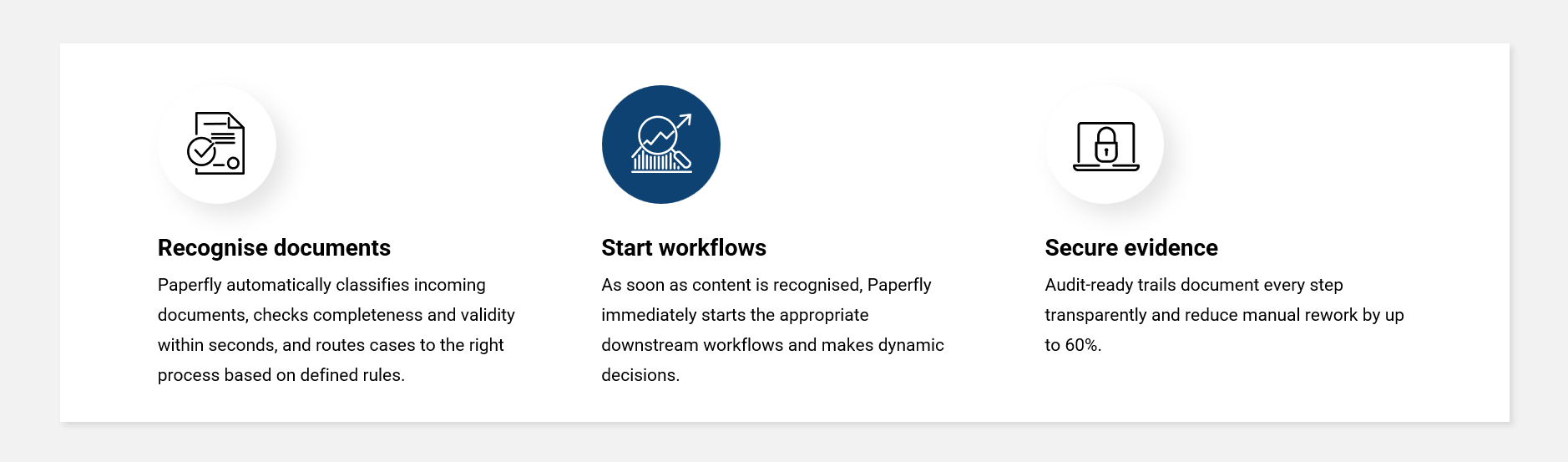
Micro ROI: -60% rework thanks to automated completeness checks.
Audit-Ready: Reliable Compliance Support with AI Agents
For banks operating in Germany, AI-supported mailrooms can help implement German regulatory requirements such as MaRisk, BAIT and GoBD, alongside the EU-wide GDPR framework, by ensuring that documents are captured completely, classified and logged in an audit-proof manner. This creates audit trails with traceable decision paths that reduce compliance risks and accelerate audit processes.
Tangible Benefits for Banks:
- GDPR Compliance: Personal data can be identified and classified automatically and processed according to defined data protection requirements.
- Standardisation: Consistent document classification simplifies internal and external audits.
- Faster Decisions: Compliance teams receive structured information directly from the workflow.
Without automated classification, manual review effort increases because incorrect or inconsistent document assignments are often only discovered during later checks or audits.
Roadmap to Automated Mailroom Processing with AI
Implementation takes place step by step: select document types, define decision logic, launch a pilot, measure KPIs and then scale. What matters are clearly defined roles, clean workflow mapping and continuous monitoring, not the technology alone.
After the test phase, rollout takes place in clearly defined stages, allowing risks to be minimised and employees to be involved early. Our experience shows that banks achieve economies of scale significantly faster with a phased approach while meeting compliance requirements reliably.
Roadmap for Decision-Makers: Digitalising the Mailroom with AI
Analysis & Goal Definition- Capture document volumes (incoming per day/week)
- Classify document types (for example loan applications, cancellations, insolvencies)
- Define KPI targets (processing time, error rate, resource usage)
- Define processing components: OCR & AI agents for semantic analysis
- Define decision logic: rules, prompts and escalation paths
- Define interfaces: connection to DMS, specialist systems and core banking IT
- Run a pilot with selected document types
- Measure KPIs: time savings, error reduction and workflow performance
- Gather feedback from specialist departments
When AI Mailrooms Make Sense, and When They Do Not
Suitable for:
- high document volumes with recurring structures
- structured forms as well as partially structured or unstructured documents
- processes with clear rule or risk logic
Not suitable for:
- individual case decisions with bespoke review processes
- very low document volumes
How AI Agents Transform Workflows in Banks
AI agents take on key tasks in modern banking processes that have traditionally still been handled manually. By automating routine tasks, banks not only reduce manual intervention but also increase process speed.
Tasks & Benefits of AI Agents
| Task | Description | Benefit for the Bank | Practical Example |
|---|---|---|---|
| Classify Documents | Automatic assignment to categories / specialist departments | Faster processing, reduced misclassification | Loan applications → directly to the operations team |
| Review Contracts | Content review, completeness and compliance checks | Error reduction, risk mitigation | Cancellations → automatically check winback offer |
| Start Workflow | Automatic routing, escalation or notification | Time savings, consistent processes | Insolvency documents → Legal + Accounting |
| Dynamic Decisions | Assessment of multiple options | Flexibility, individual handling | Discount offers, special campaigns, escalations |
Measuring AI Agent Success: Metrics, ROI and Optimisation Potential
Success is measured through throughput, processing time, error rate, STP rate (Straight-Through Processing), resource usage and ROI (Return on Investment). What matters is not time savings alone, but the proportion of documents processed correctly from end to end. AI delivers a rapid return when rework and resource requirements fall.
Key KPIs for AI Document Automation
| KPI | Definition | Before (Manual) | After (AI Agents) | Benefit |
|---|---|---|---|---|
| Throughput Rate | Number of documents processed per day | 50-100 | 1,000-5,000+ | Increased Productivity |
| Error Rate | Share of documents processed incorrectly | 2-5% | 1-3 % | Consistent Quality at Human Error Level |
| Processing Time | Time per document from receipt to approval | 30-60 min. | Sekunden bis Minuten | Faster Customer Responses |
| ROI | Savings from reduced manual work versus investment costs | - | Positive Return After 3-6 Months | Economic Benefit, Scalability |
| Resource Usage | Number of FTEs (Full-Time Equivalents) required to process approximately 3,000-5,000 documents per month | 5-8 | 1-2 | Reduced Staff Workload, More Focus on Value-Adding Activities |
In a pilot with high document volumes, around 4,000-6,000 documents per month, staffing effort for capture, classification and routing was reduced from approximately 6 to 2 FTEs while maintaining consistent processing quality.
Measurement framework (pilot): period: 3 months · population: high-volume incoming documents, for example applications, cancellations and service correspondence · volume: approximately 4,000-6,000 documents per month · method: before/after comparison · KPIs: processing time, throughput, error rate and FTE usage · data sources: workflow logs, classification logs and time records.
Conclusion & Outlook: Future-Ready Mailrooms
AI-supported mailrooms improve efficiency and process quality by analysing documents automatically, initiating decisions and standardising checks. Banks benefit from lower costs, faster workflows and scalable systems that support strategic digitalisation in core banking operations.
Banks that combine OCR and AI agents benefit from:
- Efficiency: Bearbeitungszeiten werden um bis zu 80 % reduziert, Durchsatz und Ressourcenplanung optimiert.
- Error Reduction & Compliance: Standardised classification, audit trails and GDPR-compliant processing minimise risks.
- Dynamic Workflows: AI agents make decisions beyond binary yes/no options, increasing flexibility and process stability.
- ROI: Investments in AI typically pay back within a few months through reduced staffing costs and lower rework.
- Scalability: Digital mailrooms can be scaled easily as document volumes grow, without requiring additional staff resources.
Practical Outlook:
- Further Development of AI Capabilities: Future trends point towards more context-based analysis, predictive escalation paths and automated decisions with strong relevance for customer retention and risk management.
- The Value of AI Agents Does Not Lie in Perfection, but in scalable, consistent quality at human error levels, combined with speed, transparency and clear governance.
Banks that transform their mailroom processes with AI now can secure a long-term competitive advantage: faster, lower-error processes, greater compliance assurance and a foundation for scalable digital banking processes in the future.
How Banks Strengthen Their Digital Capabilities
Digital Capabilities for Banks: Efficiency Gains & Better Customer Experiences
Does your bank want to process incoming documents faster, with fewer errors and in an audit-proof manner?
Paperfly provides a ready-to-use platform for AI-based document processing and workflow automation.
We will show you live how simple it can be.
Paperfly's 4-Phase Model for AI-Based Mailrooms
Phase 1: Analysis & Goal Definition
Phase 2: Model and Workflow Design
Phase 3: Pilot
Phase 4: Rollout & Scaling
Frequently Asked Questions (FAQ) About AI Mailrooms in Banks
Which Compliance Requirements Can AI Support in the Mailroom?
For banks operating in Germany, AI-supported mailroom processes can help implement German regulatory requirements such as MaRisk, BAIT and GoBD at process level, alongside the EU-wide GDPR framework. Complete audit trails, standardised classifications and automated checks support regulatory traceability, minimise compliance risks and simplify internal audits and external reviews.
Which Documents Can an AI Agent Process Automatically?
AI agents can process a wide range of document types, including loan applications, contract documents, cancellations and insolvency documents. Unstructured or handwritten documents can also be classified, checked and routed directly into the appropriate workflows.
How Can AI Be Integrated into Existing Banking IT?
Integration is carried out through a SaaS solution, such as Paperfly, and standardised interfaces to core banking systems. Paperfly features enable additional automation for document workflows, identity verification and AI orchestration without requiring changes to existing IT structures.
Which KPIs Are Relevant for Measuring Success?
Relevant KPIs include processing time per document, error rate, throughput, resource usage and ROI. Through continuous monitoring, banks can assess efficiency gains, cost savings and process stability, and adapt AI agents dynamically to new document types or process requirements.
How Much Time Does an AI Mailroom Save Compared with Manual Processing?
AI-supported mailroom processes reduce processing time per document by up to 70–80%, as automated classification, semantic analysis, and workflow triggers take over routine tasks. This allows employees to focus on value-adding activities while significantly increasing throughput and response times.
How Do Dynamic Agent Decisions Work?
AI agents do not make purely binary decisions, but consider multiple options at the same time. They analyse document content and predefined rules to orchestrate workflows, escalate exception cases and trigger individual actions such as winback offers or customer notifications.
How Does AI Improve Mailroom Processing in Banks in Practice?
AI reduces manual review, automatically identifies document types and routes cases into the appropriate workflows without delay. Semantic analysis reduces error rates while increasing throughput and response speed. Banks benefit from faster processing, consistent quality and audit-ready documentation of all decisions.
What Role Does AI Play Compared with Traditional OCR?
OCR merely reads characters, while AI understands and structures content and triggers complete process steps. This results in fewer follow-up questions, automated validations and higher STP rates. AI combines text recognition, contextual analysis and workflow logic into a system that intelligently orchestrates and standardises processes.
Mini Glossary
AI Document Processing= A combination of OCR and semantic analysis that understands, classifies, and automatically triggers process steps.
AI Agents= Software-based components that analyze documents, evaluate them based on rules and prompts defined by the bank, and automatically trigger standardized process steps or prepare them for decision-making.
No-Code-Based Workflow Integration = A simple technical integration where documents flow automatically between the inbox, the specialized department, and the core system.
Audit Trail = Audit-proof recording of all processing steps, decisions, and user actions.
OCR = Text recognition technology used to digitalize documents.
STP Rate = The percentage of processes handled entirely without manual intervention.
FTE = Full-time equivalent (FTE) used to measure personnel capacity.
Head of Compliance = assesses completeness and classification.
Specialist Department = prioritises cases based on AI-supported recommendations. Internal Audit: uses audit trails for faster reviews.